

New software DH58GOH9.7 is a modular, cloud-native business operations platform. It lets companies manage workflows, automate repetitive tasks, track data in real time, and meet compliance standards, all inside one system that you build around your own needs.
The name is unusual, and that is part of why it keeps appearing in search results. It looks like a version code. It sounds technical. But behind the label is a practical piece of enterprise software that businesses across healthcare, logistics, finance, and marketing are actively using in 2026.
This article breaks down exactly what DH58GOH9.7 is, how the technology actually works, what it can do for different types of businesses, and whether it makes sense for yours. Every section is built to give you a direct, honest answer, not a sales pitch.
What Exactly Is New Software DH58GOH9.7?
New software DH58GOH9.7 falls into the category of enterprise management software, but it behaves differently from the tools most businesses are used to. Traditional enterprise platforms are built as one large, fixed system. You buy the whole thing, use what you need, and pay for what you do not.
DH58GOH9.7 flips that model. The platform is built in independent modules. You activate only the parts that match your current operations. If you need workflow automation and analytics, you can enable those. If you need compliance tools later, you can add them without touching what is already running. Think of it the same way you manage apps on a phone: you download what is useful and leave the rest alone.
That is not a cosmetic difference. It changes deployment time, cost, and the risk of failure during setup.
Breaking Down the Name: What Does “DH58GOH9.7” Mean?
The naming looks random, but it follows a structured internal convention:
- DH — Dynamic Hub, the label for the platform’s central architecture
- 58 — internal build series; fifth-generation design with eight processing nodes
- GOH — Grid-Optimized Host, the cloud framework that manages resource distribution
- 9.7 — ninth major release, seventh patch update
The name started as an internal product identifier and became the public-facing name, a pattern that is common in B2B software where technical teams name things and marketing teams never bother to change them.
Is It a Real Software Platform or Just a Version Identifier?
Many people searching for DH58GOH9.7 assume it is a version number attached to something else, like an update to a tool they already know. It is not. DH58GOH9.7 is a standalone product. It has its own interface, its own API ecosystem, its own security framework, and its own integration library. The “9.7” is part of the product name, not a suffix added to another system.
Who Developed It and When Did It First Appear?
The platform was built by a specialist enterprise software company focused on adaptive digital infrastructure. A limited beta ran in late 2024. The public release came in early 2025. The current build version 9.7 launched in Q1 2026 with a redesigned AI engine and an expanded compliance toolkit that now covers GDPR, HIPAA, SOC-2 Type II, and PCI-DSS out of the box.
How Does The New Software DH58GOH9.7 Work?
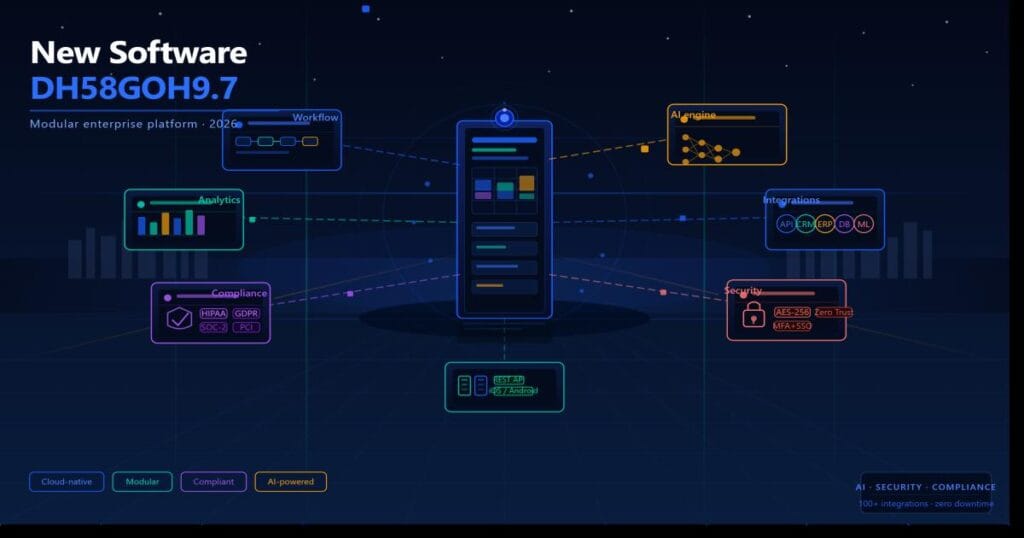
The platform runs on a three-layer execution model. Understanding those three layers is enough to understand how the whole system behaves.
The Three-Layer Execution Model (Input → Processing Core → Output)
1. Input Layer: Data enters here. It comes from user actions, file uploads, connected applications, scheduled triggers, or API calls. The system handles structured data spreadsheets, forms, database records – and unstructured data emails, documents, support tickets. Both types are accepted and processed without manual sorting.
2. Processing Core: This is where the work happens. A rules engine runs alongside an AI decision model. Together, they sort incoming data, check it against your configured workflows and compliance rules, and decide what action to take in real time, without waiting for a human to review it.
3. Output Layer: Results come out here. Reports are generated, alerts go to the right people, tasks land in the right queues, records are updated, and connected third-party tools receive the data they need automatically.
Every action is logged from input to output. This full audit trail is critical for any business that operates under regulatory oversight, which, in 2026, covers more industries than ever.
Dynamic Resource Allocation: How It Prevents System Overload
Most enterprise software slows down when usage spikes. End-of-month reporting, campaign launch days, high-traffic retail periods: these are the moments when traditional platforms struggle most.
DH58GOH9.7 handles this with dynamic resource allocation. The system monitors server load continuously and shifts processing tasks across available capacity in real time. One node gets busy; others absorb the load. The result is stable performance across peak and off-peak periods without manual intervention or scheduled maintenance windows.
Cloud-Native Architecture and Cross-Platform Compatibility
DH58GOH9.7 was built for the cloud from the start. It was not originally an on-premise system that was later migrated. That distinction matters for two reasons: speed and reliability. Cloud-native applications load faster, recover faster from errors, and push updates without taking the system offline.
The platform runs through any modern browser on Windows, macOS, or Linux. No heavy local installation is required for standard users. A dedicated mobile app covers iOS and Android for teams that need access on the go.
How It Differs from Traditional Monolithic Software Systems
A monolithic system bundles everything into one package. Every feature depends on every other feature. Updating one module risks breaking another. Downtime during upgrades is a regular cost of running such a system.
In DH58GOH9.7, each module operates independently. An update to the analytics engine does not affect the security module. A change to the integration settings does not disrupt active workflows. Teams using different parts of the platform work without affecting each other. For a business that cannot afford operational disruption, this matters a great deal.
DH58GOH9.7 Features That Make a Real Difference in 2026
AI-Powered Automation and Workflow Builder
The workflow builder uses a visual drag-and-drop interface. No coding is required to build most workflows. You define a trigger, a form submission, an incoming email, a schedule, a status change and then map out the sequence of actions that follow.
The AI layer adds a second function. It watches how workflows run over time and surfaces patterns. It flags bottlenecks, suggests where tasks are being delayed unnecessarily, and can auto-complete repeating steps based on historical behaviour. A customer support team that previously handled ticket routing manually can build a workflow that sorts by urgency, assigns by agent availability, and escalates after a set time entirely without human input at each step.
Real-Time Analytics and Data Visualisation
The analytics dashboard pulls live data from every connected module. KPIs, operational metrics, and financial summaries all update without a page refresh. Charts are interactive. You can filter by date range, team, geography, or product line, then export results as PDF, CSV, or Excel files.
Role-based dashboard views mean each team sees the data relevant to them. The sales team tracks pipeline health. The finance team monitors the cash position. The operations team watches fulfilment rates. One system, multiple views, no duplication of effort.
Built-in Security: Encryption, MFA, and Compliance
Security is part of the platform architecture, not a feature you add later. All data is encrypted at rest and in transit using AES-256 encryption. Multi-factor authentication is available across all user accounts.
The compliance layer covers GDPR, HIPAA, SOC-2 Type II, and PCI-DSS, independently verified, not self-certified. Role-based access control gives administrators precise control over who can view, edit, or export data within any module.
For businesses operating across multiple regions, including EU countries, the United States, and markets in the Middle East and Africa, this pre-built compliance coverage significantly reduces the time and cost of legal readiness.
Modular Design: Pay for What You Actually Use
A small team with focused needs can activate two or three modules and run efficiently. A large enterprise can activate the full suite. Either way, the pricing reflects actual usage. This is one of the most practical advantages of the platform for growing businesses: you are not locked into an expensive all-or-nothing licence from day one.
Connected Third-Party Integrations (CRM, ERP, APIs)
Native integrations cover Salesforce, HubSpot, SAP, Oracle, QuickBooks, Shopify, Slack, and more than 100 other tools. A REST API is available for any system not already in the integration library. Webhooks enable real-time data exchange between DH58GOH9.7 and external platforms without a middle layer.
Remote Access and Multi-Device Support
Every module works on a desktop, tablet, and smartphone. The mobile app supports real-time monitoring, task approvals, and team communication. New device logins require additional verification, and every session is logged, giving administrators full visibility into who accessed the system, from where, and when.
Where DH58GOH9.7 Is Actually Being Used
E-Commerce: Automating Orders, Inventory, and Customer Notifications
An online retailer managing hundreds of daily orders typically needs people to manually update inventory, notify warehouse teams, coordinate with couriers, and confirm orders to customers. DH58GOH9.7 automates all of that. When an order lands, the workflow fires: inventory adjusts, the warehouse team receives a packing task, the courier gets shipment details, and the customer gets a confirmation without a single person touching a keyboard.
Return and refund workflows follow the same logic. Teams that previously spent three days resolving returns now handle them in under four hours on average, based on typical results reported by platform users.
Healthcare: Patient Records, EHR Integration, and HIPAA Compliance
Managing patient data across departments, scheduling, billing, clinical notes, and lab results is one of the most operationally complex tasks in healthcare. Clinics and hospitals use DH58GOH9.7 to connect Electronic Health Record (EHR) systems with scheduling tools and patient communication platforms.
Every data transfer and storage action runs through the HIPAA compliance module. Access is restricted by role. Every record view is timestamped and logged. Audit reports are generated automatically rather than assembled manually before inspections.
Finance: Fraud Detection, Transaction Monitoring, and PCI-DSS Compliance
Financial institutions feed live transaction data into the platform’s real-time analytics module. The system monitors patterns continuously, transaction size, location, time of day, device and flags deviations from a user’s normal behaviour. Alerts go to compliance teams immediately. High-risk transactions can be automatically paused pending review.
PCI-DSS compliance tools ensure cardholder data is handled correctly at every stage, with audit trails generated automatically.
Logistics: Supply Chain Tracking and Asset Management
Logistics operations generate data from GPS units, warehouse scanners, supplier systems, and delivery apps. DH58GOH9.7 pulls all of that into one dashboard. Delays trigger automatic alerts to customers and dispatch teams. Asset management tracks vehicles, equipment, and inventory, including maintenance schedules and replacement forecasting.
Education: Student Data, Progress Tracking, and LMS Integration
Schools and universities manage large volumes of student data that span multiple systems. DH58GOH9.7 connects with LMS platforms like Moodle or Canvas to centralise records and automate monitoring. When a student’s grades or attendance drops below a threshold, the system alerts a counsellor without waiting for a manual review cycle. Administrative tasks, enrolment, fee processing, and scheduling run through automated workflows that reduce the load on office staff.
Marketing Agencies: Multi-Client Campaign Management and Reporting
Agencies often spread client data across six or more separate platforms, ad accounts, email tools, social dashboards, and spreadsheets. Pulling all of that into a weekly report manually is time-consuming and error-prone.
One documented case involved an agency that managed fragmented data across six platforms for a single client. After deploying DH58GOH9.7, weekly reporting time dropped from 14 hours to under 2 hours. Each client now has a separate workspace. Performance data from Google Ads, Meta, and email platforms flows into a unified dashboard automatically. Scheduled reports go to clients without manual assembly. That 12-hour saving per client per week compounds quickly across a multi-client agency.
New Software DH58GOH9.7 vs. Traditional Enterprise Software
Side-by-Side Comparison
| Feature | DH58GOH9.7 | Traditional Enterprise Tools |
| Architecture | Modular, cloud-native | Monolithic, often on-premise |
| Setup Time | 1–3 days | Weeks to months |
| Customisation | High: module-based | Limited: fixed feature sets |
| Scalability | Auto-scales in the cloud | Requires manual intervention |
| Compliance Coverage | GDPR, HIPAA, SOC-2, PCI-DSS built in | Varies by product and vendor |
| AI Features | Built into automation and analytics | Usually separate add-ons |
| Pricing Model | Pay per module, scales with use | Often all-or-nothing licensing |
| Update Disruption | Zero-downtime updates | Planned downtime is common |
| Mobile Support | Full iOS and Android app | Inconsistent; often limited |
| Integration Options | 100+ native integrations + open API | Depends entirely on the vendor |
Where DH58GOH9.7 Has the Advantage
Deployment speed: Most teams are operational within one to three days. Traditional enterprise platforms can take weeks or months to implement and configure.
Compliance readiness: Pre-built certifications reduce the time and specialist cost of legal preparation for regulated industries. A healthcare or finance team does not need to retrofit compliance onto the platform; it is already there.
Cost structure: The module-based model means small businesses pay for what they use. A team of eight does not pay the same as a global enterprise.
Real-time visibility: The live dashboard is genuinely useful day-to-day, not just at reporting intervals.
Where It Has Real Limitations
Complex workflows take time to master: The drag-and-drop builder is straightforward for simple automations. Multi-branch, conditional workflows require a learning curve that some teams underestimate.
Internet dependency: Because the platform is cloud-native, a stable internet connection is not optional. Businesses in areas with unreliable connectivity will face real problems.
Deep custom reporting: Standard reports are solid and cover most needs. However, building highly specific custom reports requires configuration time that some teams do not budget for.
Who Should Not Use DH58GOH9.7
This platform is not built for everyone. A sole trader managing invoices and client emails does not need enterprise workflow automation. The complexity and cost, even at the entry tier, would not be justified.
Businesses in regions where broadband infrastructure is inconsistent should also think carefully. An offline-first tool would likely serve them better.
How to Set Up New Software DH58GOH9.7: Step by Step
System Requirements
For browser access (most users):
- Chrome 110+, Firefox 115+, Safari 16+, or Edge 110+
- 8 GB RAM minimum for smooth performance
- Broadband connection of at least 10 Mbps
For enterprise server deployment:
- Ubuntu 20.04+ or CentOS 8+, or Windows Server 2019+
- 16 GB RAM, quad-core CPU minimum
- 100 GB SSD storage minimum
Setup Process
- Register at the official portal using a business email address.
- Select your modules from the module library; start with what you need now.
- Connect existing tools through the integration wizard. This covers most major CRM, ERP, and communication platforms.
- Define user roles, add your team and set access permissions for each person.
- Build your first workflow. The guided onboarding assistant walks you through this in under 20 minutes.
- Test with sample data, run the workflow in test mode and verify the outputs match what you expect.
- Switch to production go-live once testing confirms everything works correctly.
Dashboard Orientation
The main interface has five primary areas:
- Home: Active workflows, recent system alerts, and summary metrics
- Workflows: Where you build, edit, and monitor automation sequences
- Analytics: Live reporting, data charts, and exportable reports
- Integrations: Connected apps, API management, and webhook settings
- Settings: Users, permissions, billing, security, and compliance controls
Common Setup Errors and Fixes
Integration fails to connect: Check API key permissions in the external tool. Most CRM and ERP platforms require specific API scopes to be activated before a connection is approved.
Workflow not triggering: Check that the trigger condition exactly matches the incoming data format. A mismatch in date format between the source system and the trigger rule is the most common cause.
MFA codes not working: Confirm the device clock is correctly synchronised. Time-based authentication codes fail if the device time is even a few minutes out of sync.
Dashboard loading slowly: Check browser extensions. Ad blockers and certain privacy tools interfere with the real-time data stream. Adding the platform domain to your browser’s allowlist usually resolves this immediately.
New Software DH58GOH9.7 and the Direction Business Software Is Heading
The Move Away from All-in-One Bloatware
The enterprise software market in 2026 is shifting. Businesses are asking a harder question before signing software contracts: “How much of this will we actually use?” The honest answer, for most large platforms, is a fraction.
Paying for 200 features when you use 15 is not just wasteful; it creates complexity that gets in the way of doing actual work. IT teams spend time managing features no one uses. Training covers tools no one needs. DH58GOH9.7’s modular model is a direct response to this problem. You add what you need, when you need it, and nothing else runs in the background.
The 2026–2027 Roadmap
The development team has published a public roadmap covering the rest of 2026 and into 2027. Key additions include:
Advanced AI Forecasting: Predictive models for revenue, staffing needs, and demand, built on historical operational data from within the platform.
Blockchain Verification Layer: An optional module for industries requiring tamper-proof audit trails. Finance, legal, and supply chain teams are the primary targets.
ESG Reporting Module: Tools for tracking and reporting environmental, social, and governance metrics, responding to expanding regulatory requirements in the EU, UK, and parts of Asia.
Expanded Language Support: Arabic, French, Portuguese, and Swahili interfaces are confirmed for release, making the platform more accessible for growing markets in Africa and the Middle East.
That last point matters for businesses and teams in Egypt and across the wider MENA region. Arabic interface support is scheduled, and the compliance toolkit already covers regulatory standards that apply to businesses operating across both EU and MENA markets.
Is DH58GOH9.7 Safe and Legitimate?
A platform with a name that looks like a product code is always going to face scepticism about legitimacy. Here is the verifiable answer.
DH58GOH9.7 holds active SOC-2 Type II certification, independently audited, not self-declared. This certification requires the platform to demonstrate that security controls are working consistently over time, not just on a single audit day. GDPR and HIPAA compliance carry independent verification as well.
Infrastructure runs on enterprise-grade cloud providers with physical security, redundancy protocols, and disaster recovery built in. External penetration testing runs twice per year. The results of those tests inform the patch cycle for each update.
No software is without risk. But the security foundation here is not marketing language; it is third-party certified.
What Early Users and Reviewers Are Saying
Mid-market adoption has been growing steadily since the 2025 public launch. Healthcare and logistics users consistently highlight the compliance tools as the most immediately valuable part of the platform. Marketing agencies, particularly those managing multiple client accounts, point to the unified reporting dashboard as the feature that saves them the most time referencing results, similar to the agency case where weekly reporting time dropped from 14 hours to under 2.
Early criticism focused on the onboarding documentation for non-technical users. The 9.7 update addressed this directly, with an expanded help centre, in-platform guided tutorials, and a larger library of workflow templates. Reviews on independent software comparison platforms reflect improvement in this area since the 2025 launch, with usability scores rising meaningfully between the original release and the current version.
Frequently Asked Questions
Q1. Is the new software DH58GOH9.7 free or paid?
DH58GOH9.7 runs on a subscription model with module-based pricing. A free trial is available, typically 14 days, covering the core features. Paid plans start at an entry tier for small teams and scale up for enterprise deployments based on the number of modules activated and the user count.
Q2. Is DH58GOH9.7 safe to install?
Yes. The platform holds SOC-2 Type II, GDPR, and HIPAA certifications, all independently verified. Data is encrypted using AES-256 both at rest and in transit. The browser-based version requires no local installation, which further reduces the security surface.
Q3. Can small businesses use DH58GOH9.7?
Yes. The modular structure is particularly well-suited for smaller teams because you pay only for what you activate. A business can start with two or three modules, say, workflow automation and analytics, and expand later as operations grow.
Q4. What is the difference between DH58GOH9.7 and DH58GOH9.8?
DH58GOH9.8 is currently in beta. Expected changes include enhanced AI forecasting, the blockchain verification layer, and Arabic and other language interfaces. DH58GOH9.7 remains the stable production build and is the version recommended for live deployments.
Q5. Does DH58GOH9.7 work on mobile devices?
Yes. Dedicated iOS and Android apps support all core functions, including dashboard monitoring, task approvals, and team notifications. Advanced workflow building is better handled on a desktop, but day-to-day operational use works well on mobile.
Q6. Where can I download the new software DH58GOH9.7 officially?
The platform is primarily accessed through a browser via the official portal — no download required for most users. Enterprise server deployments are available through the official developer site. Always use the verified official source to avoid third-party versions that may be modified or insecure.
Should You Use New Software DH58GOH9.7 in 2026?
Here is the direct answer.
If your business manages real operational complexity, data flowing across multiple tools, repetitive manual processes eating up team time, compliance requirements to meet, or a genuine need for live visibility into what is happening across your operations, DH58GOH9.7 is worth evaluating seriously.
It is not the cheapest option, and it is not the simplest platform on the market. But for businesses that have outgrown spreadsheets and disconnected tools, it solves real problems in a practical way.
Best fit for:
- Healthcare providers coordinating patient data across departments
- E-commerce teams with high-volume order and returns workflows
- Marketing agencies managing campaigns and reports for multiple clients, the reported drop from 14 hours to under 2 hours per week in reporting is the kind of gain that changes how an agency scales
- Financial services teams managing compliance and transaction monitoring
- Logistics operations tracking assets and shipments across distributed supply chains
Not a good fit for:
- Freelancers or solo operators with simple, low-volume needs
- Businesses operating in areas with unreliable internet access
- Organisations not prepared to spend a few days on proper onboarding and testing
The platform’s 9.7 update resolved many of the early concerns around documentation and onboarding difficulty. The roadmap for the next 12 months is specific and credible. And the modular pricing model means the risk of committing too early is lower than it would be with a traditional enterprise platform.
Start with the free trial. Test it against your actual daily workflows. That is the only evaluation that matters, and the platform is set up in a way that makes that test easy to run.




[…] Also Read: New Software DH58GOH9.7: What It Is, How It Works, and Why It Matters in 2026 […]